Capper-Cramton Act
Author: Seventy-First U.S. Congress
Date: May 1930
PDF Source: National Capital Planning Commission
Description
Public Law No. 284 funded park acquisitions and greatly strengthened the Commission’s regional planning functions. In providing funding on a local/federal cost sharing basis, the act served as a model for similar grant programs later instituted in other parts of the country.
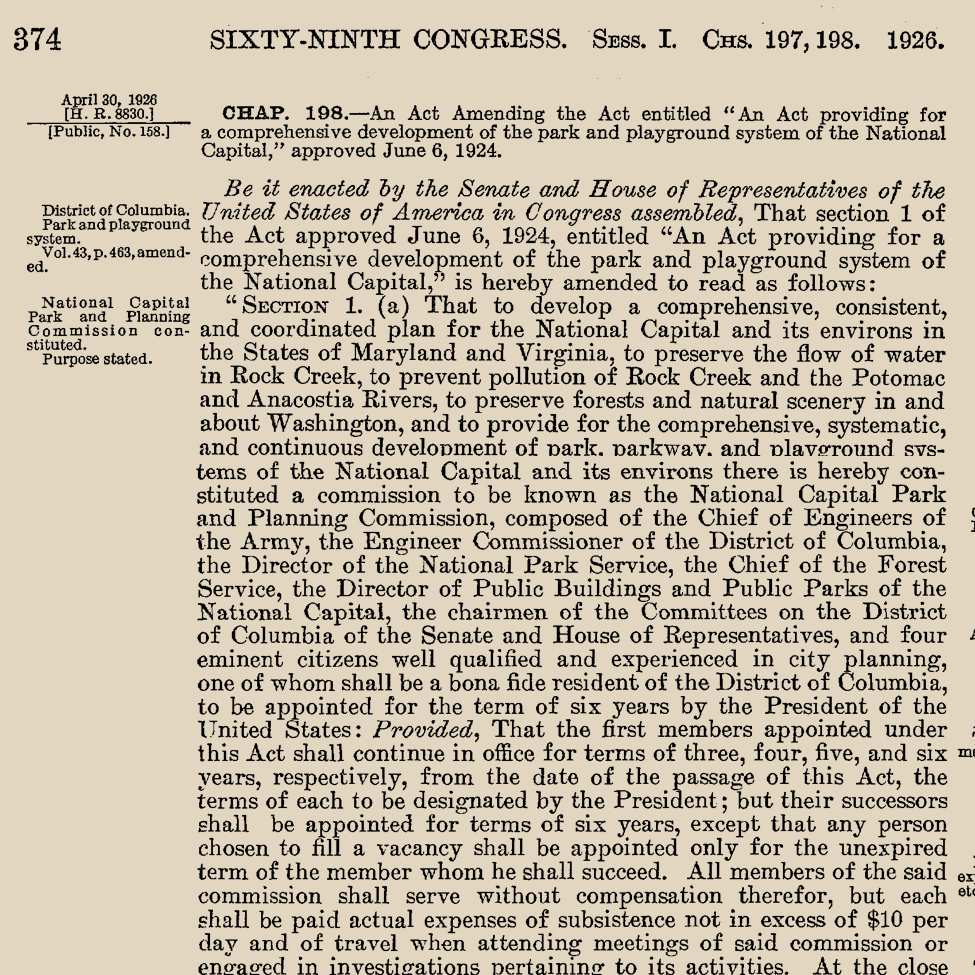
Following a period of rapid urbanization in Washington, leaders advanced multiple efforts to protect environmental resources, including a U.S. Senate park plan in 1902 (see McMillan Plan). To facilitate implementation, Congress established the U.S. Commission of Fine Arts in 1910 and the National Capital Park Commission in 1924 (see 1924 NCPC Act). Two years later Congress reorganized the latter with broader authorities as the National Capital Park and Planning Commission.
Despite planning (see 1928 NCPPC Annual Report), implementation lagged due to acquisition costs. U.S. House Representative and NCPPC ex officio member Louis Cramton and Senator Arthur Capper (who also had a crucial role in forming DC’s Alley Dwelling Authority) co-sponsored what became their namesake legislative act.
Implementing the act represented a significant amount of NCPPC’s focus during the 1930s. Maryland and Virginia’s need for federal acquisition approval and their relatively new planning staffs resulted in NCPPC assuming a large measure of responsibility for suburban planning.
The act’s legacy encompasses many of the region’s parkways and stream valleys, including the George Washington Memorial Parkway, and tributaries of the Anacostia River and Rock Creek in Maryland. NCPC’s seminal 1950 Comprehensive Plan (see 1950 park plan) illustrated the system’s development.
Current regulations reflect multiple amendments. For more information on the Act, see NCPC’s Capper-Cramton Act resource guide.