National Capital Park Commission Act
Author: Sixty-Eighth U.S. Congress
Date: June 1924
PDF Source: U.S. National Archives and Records Administration
Description
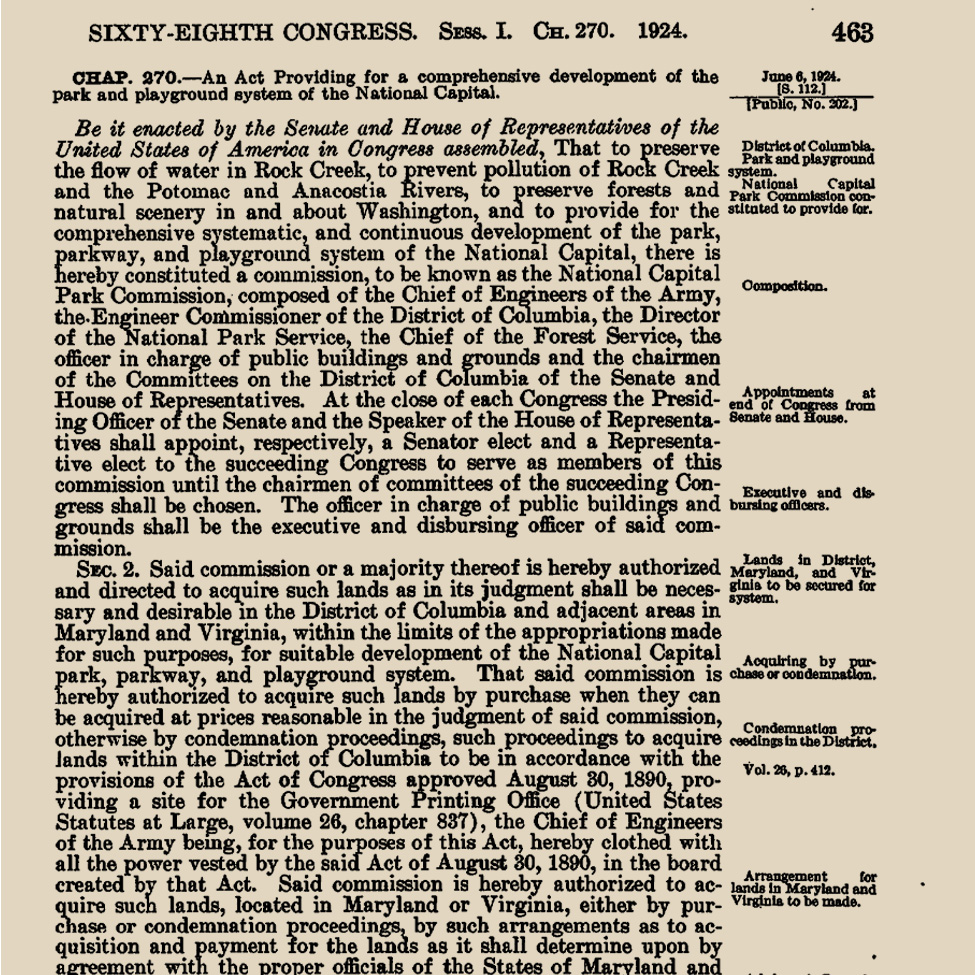
Congress established the National Capital Park Commission to plan and acquire a comprehensive park, parkway, and playground system for the National Capital.
This legislation followed congressional concerns that Washington had made limited progress toward implementing the L’Enfant and McMillan Plans, and that it’s park system lagged far behind other U.S. cities.
Congress reported interest in the government acquiring Rock Creek valleys and tributaries, Klingle Ford Valley, lands fronting on the Capitol Grounds and along Pennsylvania Avenue, and lands in Washington’s outskirts for parks and playgrounds. Congress was also interested in creating a Fort Boulevard connecting the Civil War forts, expanding Piney Branch Parkway; and developing an arboretum in the vicinity of Mount Hamilton. Recognizing that the “Capital City” expanded into the surrounding states, Congress also expressed interest in securing lands in Maryland and Virginia, including the Rock Creek valley; both banks of the Potomac River up to Great Falls, Sligo Valley, and areas encompassing the Civil War forts. It conveyed interest in developing park boulevards to Mount Vernon and Fort Washington; forested parkways extending north along 16th Street; a park boulevard toward Baltimore; and three park boulevards radiating from the Memorial Bridge terminus in Virginia.
To accomplish these tasks, the act designated a seven-member commission “composed of the Chief of Engineers of the Army, Engineer Commissioner of DC, the Director of the National Park Service, Chief of the U.S. Forest Service, the officer in charge of public buildings and grounds, and the chairmen of the Committees on the District of Columbia of the Senate and House of Representatives…The officer in charge of public buildings shall be the executive and disbursing officer.” Note: the commission composition generally reflected the prevailing classification of park and recreation facilities as public works.