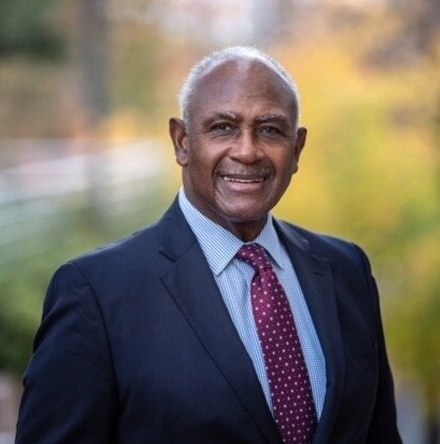
NCPC Chair
1995-2000
1995-2000
Appointed by President Clinton, Harvey B. Gantt served as Chair of the National Capital Planning Commission from April 1995 to December 2000. Under his leadership, NCPC published the visionary planning document Extending the Legacy: Planning America’s Capital for the 21st Century, which informed the Memorials and Museums Master Plan. During his tenure, the Commission reviewed plans for the World War II Memorial, Martin Luther King, Jr. Memorial, and Walter E. Washington Convention Center. Mr. Gantt was the co-founder of Gantt Huberman Architects, a firm based in Charlotte, North Carolina, the city’s first African American mayor, and NCPC’s first African American Chair.
"While we want to glorify our history and place monuments … that were attractive to the nation, we couldn't do things that undermined the quality of life in neighborhoods"
Policy & Research Division Director Michael Sherman interviewed Chair Gantt on May 15, 2023.
Download Full Transcript MR. MICHAEL SHERMAN: Tell us a little bit about your early life and career, where you grew up, and your education, and maybe what experiences helped shape your interest in urban design and city planning.
CHAIR HARVEY B. GANTT: I was born and raised in South Carolina, Charleston, born on one of the many islands surrounding the peninsula of Charleston. My father grew up on a farm. My mother also grew up on a farm. I lived on a farm for the first four and a half years of my life and then moved to Charleston, South Carolina, 26 miles away from where I was born, to public housing with my family, which at that time was comprised of myself and an older sister. My father got a job in the Charleston Naval Shipyard, so he traveled initially 26 miles every day, then moving into the housing. That public housing was a little different from the public housing we often think of today. That housing was built by the government to house people who would work in the war industries, or in this case, more specifically, the Navy Shipyard there in Charleston. I spent about three years in public housing, and then my family moved into downtown Charleston in a house that my father built.
I had a relatively uneventful childhood, growing up in a segregated environment, that I quite frankly, except for the indignities of segregation, grew up almost without full awareness of what the South was all about, as a little boy. That’s another way of saying that we had a very loving childhood, parents that loved us, and education was taught to us and preached to us, as a necessity, and there was no question that we were going to go beyond high school. My parents were not high school graduates. My mother finished 11th grade. My father finished 8th grade. But they saw education as the key to our future. I had four sisters, all younger than me, and so I was the protector of the girls, so to speak. I graduated ultimately from Burke High School in Charleston, where I had been introduced to architecture by a 10th grade teacher who was building on a reputation I had as being a great sketcher and guy who could use the pencil very well in sketching. He said, “You ought to take that talent and become an architect.” I didn’t know what that was all about!
I had never heard of an architect, really. And, because of the segregated environment that we lived in, I could not visit an architectural office in Charleston, there were no Black architectural firms, and it was unheard of for a Black kid to be even roaming around an architect’s office. But that didn’t stop me. I had a great guidance counselor who shepherded me ultimately to a Midwestern predominantly white institution, which was my first experience away from segregated schools. I did reasonably well at Iowa State University. I spent a year, ultimately about a year and a half, but at the end of that first year, almost the end of the first year, I decided I didn’t want to live in the North, and so I made an application to Clemson University. After about five applications and a lawsuit, I became the first African American to go to school there, in 1963. And someone would say, “The rest is history.” Has become history, being the first African American to go to a public school in South Carolina.
In the course of my architectural studies, I obviously became interested in planning. Even when I graduated from Clemson and went to live in Charlotte, the notion of designing beyond the small site that architects work on, to looking at the bigger city, was fascinating to me. After three years and applying for a license in architecture, I decided the direction I really wanted—I wanted to detour from the architectural career, shall we say, and pursue—or find out more about what cities were all about. Hence, the luckiness of becoming a HUD Fellow, Housing and Urban Development Fellow, back then, where they were encouraging more and more people to study city planning. I went off to MIT and got a degree in planning, after a couple years, and then moved back south, to pursue that in every way, shape, or form.
MR. SHERMAN: What brought you to Washington? And can you tell me about some of your favorite places in Washington?
CHAIR GANTT: Well, before I get to Washington, I do want to say that I spent some time—in fact, the only reason I got to Washington was politics. Let me just put it that way. I wasn’t some nationally or internationally known planner or architect, but I served as mayor of Charlotte for a couple terms in the eighties and then ran for the Senate in the nineties in North Carolina. That’s when maybe I came to the attention of the esteemed president of the United States at that time, Bill Clinton, because we helped him in his campaign, and we thought a lot of him. I became an appointee of his in 1995. That's what ultimately brought me there. He knew of my interest in cities. I had always thought Washington was a wonderful city, one of the first really planned cities in America. And, it had a certain grandeur about it, that you knew you were in Washington, rather than any other city in America. The great streets, the great monuments, the juxtaposition of the Capitol, the White House, and the other monumental buildings there. I had a little bit of a love for those spaces.
I still think that the Capitol and the White House and the Mall are kind of the things that make me recognize the might and power of our country. The Lincoln Memorial is a place that I've always visited when I went to Washington. More recently, you might expect that I might have wandered by some of the things that the NCPC was involved in causing to come to reality, and those are obvious—the Martin Luther King, Jr. Memorial in the Tidal Basin; in my case, the Washington Convention Center; and the World War II Memorial.
So, I guess I didn’t give you a favorite place. There are just lots of places that you wander around monumental Washington and you see. And you're kind of happy that the Washington skyline is different from any other city in America, largely because of planning because, when we show any city, including my own—Charlotte, North Carolina—we recognize those cities by what? The skyscrapers downtown. And I can tell Chicago from New York from San Francisco from LA. But you always know when you're looking at Washington, DC. And I thank God for the prohibition that they don’t allow you to build 50-story towers in the downtown of Washington.
MR. SHERMAN: That notion of the Height Act has resurfaced recently.
CHAIR GANTT: Oh, it was always going to resurface! The pressure of developers to want to build taller is going to always be an ongoing issue at NCPC.
MR. SHERMAN: Turning to your time on the Commission, can you talk about some of the projects that stand out to you?
CHAIR GANTT: What I’m most grateful for is that in the five years that I was there, we did some very substantial things that, while they didn’t come into fruition while I served, they were planned, and the debates and the public hearings and testifying before Congress, all of that occurred. That’s why when I go back to visit now, you begin to say, “Well, I see some of what all that hard work was about.” The Legacy Plan was well underway by the time I got to assume the role of chairman. It, to me, was very sensible and made a lot of sense. I used to say, “You can’t crowd everything on the Mall.” You've got to take advantage of some natural amenities that the city has—the wonderful rivers that border it, the underused waterfront. There was a monumental Washington, that’s where everybody tried to crowd every monument—and this plan opened up opportunities for different sites and such. So, I was excited by it, but I did not feel as if I was substantially involved, nor the Commission, at that time. We were really basically in the process of trying to get approval for it, and to get the machinery of Washington to get behind it and adopt the plan, and so forth and so on. But it was exciting, from the standpoint that I could say, to my children and grandchildren, when we see a monument now that is not—a new one, that’s not in the normal places—that that’s part of the Legacy Plan.
When we see certain streets now becoming a little bit more prominent, we can say, “That’s a part of the Legacy Plan.” To spread the good flavor of Washington throughout the community without being intrusive to neighborhoods, but in fact enhancing the experiences that people will have visiting Washington. From that standpoint, we didn’t do much of the original work on that as much as we sought to support the work of former Chairman Urquhart and some others who spent more time dealing with that.
I think what stands out in my mind are two, maybe three, projects that we spent some time on. One of them was the World War II Memorial. In fact, we spent a lot of time on that, first getting a site, trying to avoid any fights with the Commission of Fine Arts; trying to decide how to make this meaningful; trying to deal with the pressure of Congress and others who said it was time that we built this monument. I do remember many meetings on this plan, this World War II Memorial. And I sat in any number of design sessions, from the winning design, to the revision of the winning design, to all the issues that are associated with that. I was like in hog’s heaven in one sense because I enjoyed it, probably more so than some other members of the Commission might have enjoyed it, especially the back and forth between the architects and the planners, and myself and other members of the Commission.
MR. SHERMAN: A lot of spirited debate.
CHAIR GANTT: It was spirited. I would love to be able to have gone back and read the minutes of some of those meetings that sometimes lasted a good little while. But anyway, the World War II Memorial stands out. The Martin Luther King, Jr. Memorial stands out, because we just couldn't decide on where to put the great civil rights leader, one of the most important men in our history. I recall us dealing with everything from the Alpha Phi Alpha Fraternity and listening to what they wanted to see and attending some of their sessions to listen, to then ultimately having a debate about where the site was going to be. I was trying the best I could in preparation for this interview to figure out where the ultimate sites were, but ultimately that Tidal Basin site seemed to make sense. And I don’t recall us having a big fight with CFA about that location.
I wasn’t around when the actual design of the site was done, but I must say that I’m pleased with it. Apparently, a lot of Americans are also. The question had—something about the site had something to do with how prominent it was going to be and whether or not he was being stuck away on the side, since it wasn’t right up on the Mall. Those kinds of issues came up, but I see that today, and I hear people talk about it, and I feel a sense of pride that the NCPC did a good job with that. Also, with the World War II Memorial, I hear lots of good comments about it after getting that site selected.
MR. SHERMAN: The King family just announced that this summer they're going to celebrate the 60th anniversary of the March on Washington. Do you remember where you were then?
CHAIR GANTT: I was a 20-year-old college student just having gone into Clemson. And remembering and recalling that event, and the president of Clemson calling me into his office and wanting to find out, “Were you going to go to that march?” Because a lot of people had concerns about that march becoming controversial, and maybe everything from riots and everything might occur as a result of it. Of course, the big urban riots had not occurred at that point, yet. That happened in ’64. But I ended up—I was in summer school. I was determined to graduate at a certain time, so when I entered Clemson in January of ’63, I went to school year-round, all the way to May of ’65, in order to graduate. But I remember that march, and I remember I was down at the architecture school watching it on television and must have heard that “I Have A Dream” speech about 10 times before the clock struck 12.
Think about it—I was in an era before The Great Speech, and to live, to hear about it, even still today, spoken with such energy by people who recall that experience or by watching the recording, you recognize, “My God, I was around. I was a 20-year-old. It was a pretty good speech. You didn’t know it had those kinds of legs, though. It lasted. Regrettably, regrettably—I know I’m not supposed to be political on this—regrettably, a lot of the things that Dr. King spoke about, we are actually still struggling with today, maybe even in a more—it’s an even tougher environment, because of where we are. But I certainly cherish the fact that I was old enough then to remember it.
The last major thing that I can recall us getting involved with was not so much a national monument but the placement of a facility that was an economic generator for the city of Washington, the location of the Washington Convention Center, the new one. There again I recall so many discussions about scale, appropriateness, neighborhood, whether we were going a little too far, and the disruption that might occur with other smaller historic properties in that neighborhood. I don’t remember the details of it, but I remember looking at lots of facades, designs. I’d love to know what the following reaction, now some 20 years later, has been to that. I’ve been to the Convention Center, but I’ve not seen any commentary on whether this was a good decision that we made, or just a kind of okay one.
MR. SHERMAN: That’s a broad question. If you look at it from an economic development standpoint, there were concerns about the impact on local residents and some of the local businesses, on one hand. On the other, it generates a lot of conventions, pre-pandemic, and I think it is generally viewed as a success. And I would say also generally viewed as a success from a design standpoint, because it’s able to really integrate into the community, given the scale and massing of that facility compared to other projects of this size and nature in the city.
CHAIR GANTT: I’m glad to hear that the general reaction has not been negative. And clearly this was being done not so much to recall or to glorify the overall history of the country, as we would in World War II memorials or MLK memorials, but this was an economic generator that was needed in the national capital that keeps it thriving and doing well. I suspect that’s what the mayor is concerned about now when she talks about housing and retail development and more intense development, is you've got to keep the city alive and well. Even beyond the monuments.
MR. SHERMAN: Are there other planning topics that you recall, or that you think were important? We've mentioned current issues around revisiting the Height Act, but I think you might recall back in the late nineties, security concerns and things like that became even more prominent.
CHAIR GANTT: One of the sad things about the overall urban design characteristics of the city is how we have introduced security measures that keep lots of us from getting close to these buildings, but it was necessary. A goodly portion of our time was spent in the redesign of driveways and entrances and placement of bollards, and all kind of things we did to try to disguise what we were saying, all because we wanted people not to take a car and drive into a major federal building and kill a lot of people.
I was commenting to some folks how much the world is different today—we just took a trip to Europe—and how used to the security measures we have put in place. When I told my grandchildren about the times that we could take relatives to the airport and go all the way down to the gate, and if there was an elderly one, even take them on the plane and make sure they were comfortable, got off before the flight took off, and that was just routine. You could get to an airport, and you didn’t have to get there two hours beforehand. But the world has changed. That was necessary, and we've gotten even more sophisticated today about how we protect monuments in our community, not only in Washington but cities around the country, from the craziness that we see. But I think we spent a lot of time—a lot of time—and a lot of design energy was lost to make sure that we could be as unobtrusive as possible. That’s one of the kinds of sets of things that we dealt with. It’s the other smaller memorials that we spent a lot of time with, too. You didn’t hear them, they didn’t make the news, but they routinely happened, all the way out into Virginia. But the big ones—when they were big, they were big.
MR. SHERMAN: During your time on the Commission, how did you feel about balancing federal and local interests?
CHAIR GANTT: I tried first of all to listen very carefully to the representatives from the Mayor’s Office. I think we tried to be sensitive to some of the issues that were unfolding in the city. I have quite a few friends and distant relatives, not close relatives, who lived in DC at that time, and most of those people were considered by our standards even today well-off because they worked for the federal government. And most of them appreciated, I think to a large extent, the beauty of the capital itself. I never had anybody object to the work that NCPC was doing. I did not see them seeing us as an intrusive agency that affected their lives that much. I’m sure there were sometimes that we did things that they might not have agreed with, but I can’t recall, that being some 23-plus years ago, what those might have been. They don’t stand out to me at the moment.
But my sense is the Commission, led by a wonderful staff of people, (former Executive Director) Reg Griffith and others, who lived there, who were sensitive, who had their ears closer to the ground than a guy who was from Charlotte, made me as aware as I possibly could be of when we were going to be intrusive. Then, my instincts as a mayor myself was, while we want to glorify our history and place monuments and develop streets that were attractive to the nation, we couldn't do things that undermined the quality of life in neighborhoods. I remember some issues dealing with the Anacostia area, and some of the questions about the location of big-ticket items, and maybe even the improvements that people were concerned about whether we would be intrusive to neighborhoods. But my sense, at least I hope under my leadership, is that we were going to be sensitive that people really did live here, and that the monuments had to live, comfortably, with that existing population that was looking for a sustained and sustainable life.
MR. SHERMAN: There’s a greater emphasis now on diversity, equity, and inclusion. How did social issues impact your work at NCPC?
CHAIR GANTT: Social issues are going to always be there. They're going to be there another generation from now. But my sense of looking at the, first of all, any appointments that the Commission made, whether they were ad hoc or whatever, we had enough advocates on the Commission to make sure that not only was every region represented there, but that we—we didn’t call it DEI at that time; it was just, “Let’s just make sure we've got some Black folks there, and we've got some brown folks there, and that we’re hearing all the viewpoints.” But quite frankly, I don’t remember that that was an issue. There were little intramural discussions, I recall, about individual staff positions that became available, or were available, that we didn’t have any play in anyway. I don’t know whether we were calmed by the fact that we had an African American leader of the staff for a good period of my time there. But DEI was important back then. It has become an issue even more so now. I would be curious to see, for example, what the staff looks like, what the policies look like in terms of planning, whether or not we are engaging communities a little bit better than we used to. I should fully expect so.
MR. SHERMAN: Looking to the future, what aspirations do you have for the city and the region from a planning and urban design standpoint? Are there any critical issues that you think are emerging that we should be thinking about?
CHAIR GANTT: Not really, nothing critical. I still do appreciate the work that the Commission has done, and the other agencies that work on the stuff there. I should say, Washington still looks pretty much the same as it did 60 years ago. And that’s not a criticism. But I’m saying the things that make Washington recognizable is the monumentality of the city itself that says, “This is the capital of the most powerful nation in the world.” I think care and concern probably has to continue to be exerted, even more vigorously, with what happens between the big bones of the city itself, the big monuments and the streets and the avenues that are there, with neighborhoods.
I think there is probably—because I hear it from the politicians there—this resentment that Washington has no representation in Congress. That’s outside the sphere of planning, physical planning, but it does affect the spirit of a city, in that while we are working for the government, while we are voters, while we support one political party or the other, we still are like a kind of—neutered citizen, in the sense of participating in the government itself. I think NCPC, though, is in the right—we have got to want to become even more involved, to make sure that the hand of the federal government which affects where housing is put, where roads are put, where transit—that we are sensitive and respect the citizens, respect the citizens of the community. One of the annoying things about me being Chairman those five years at the end of the 20th century was many of my friends didn’t even know we existed. And they lived in Washington! We might meet, occasionally, for coffee, or breakfast, or dinner, and they said, “Now, what is it that you do?” “Oh. Well, we don’t read about you in the newspaper.” Unless of course there’s something that is of interest; a monument might be two blocks from them. But most people are not aware. And I’m not ever sure that that’s not good. Or bad.
Maybe we ought not be in their faces. Maybe people ought to be able to experience the policies and directives that are protecting them. But I don’t know how you do that without them being more knowledgeable. But some people might say, “I’m glad I’m riding under the radar. I don’t have to worry about what’s going on.” I never got letters from citizens in DC during my time, even when we were doing the Washington Convention Center. Even when we were talking about Martin Luther King. You didn’t get a barrage of letters telling you that, “We want to be involved in that discussion.” But we need not forget that there are people who live there who may have a little bit of a complex because they don’t have any representation at the federal level. For that reason, those of us who plan, or those of you who plan, what these communities will look like, need to be hypersensitive to involvement.
MR. SHERMAN: Is there anything else you want to add?
CHAIR GANTT: Let me just congratulate all of you who have chosen to dedicate your lives to working on planning, and that you never see it as a perfunctory task. That what you do is important to maintaining tradition while still looking toward making that an ultramodern and very livable and sustainable city. I just congratulate you all for what you do.